
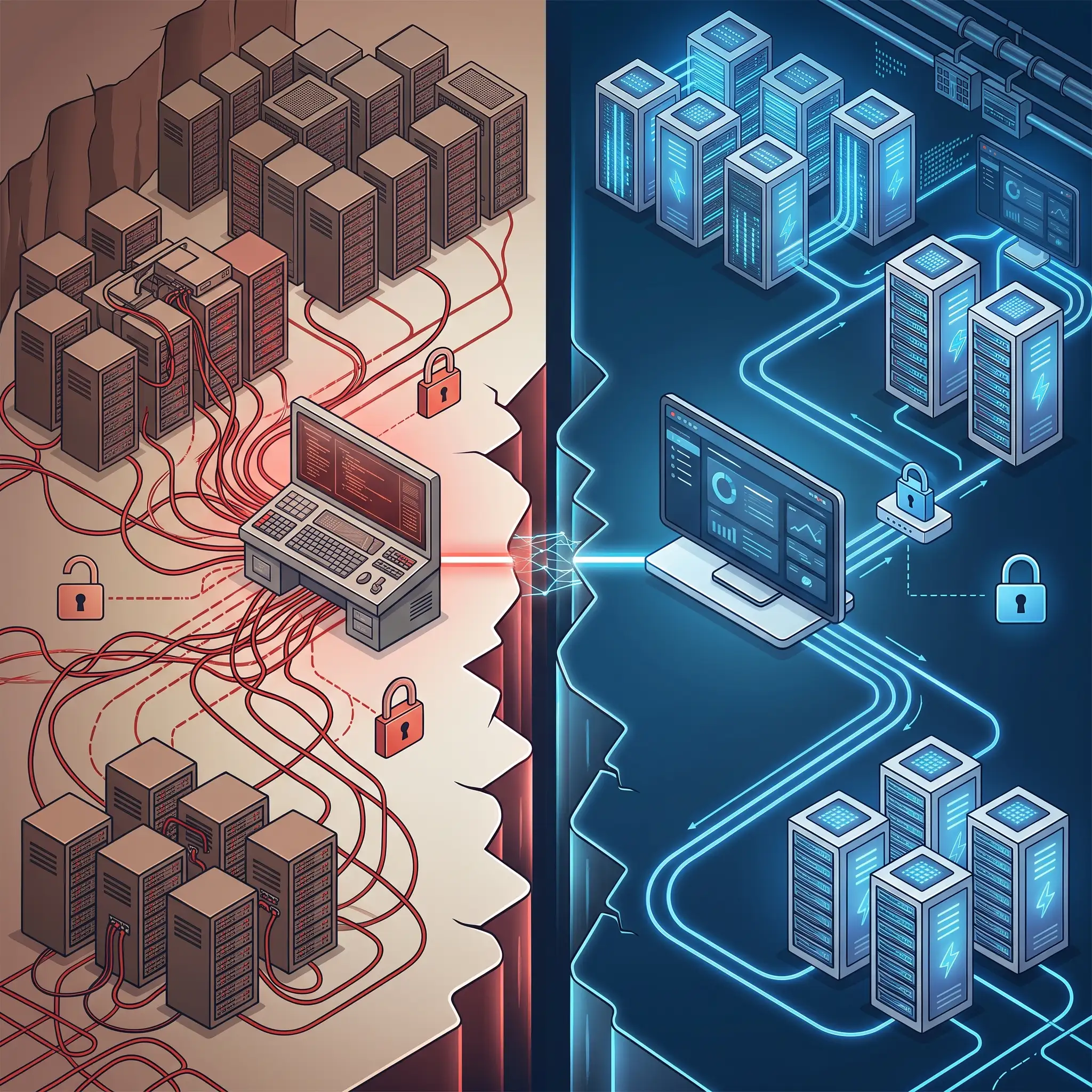
The Overlooked Danger in Modern Server Management: Architectural Risks of Traditional Control Panels

The Overlooked Danger in Modern Server Management: Architectural Risks of Traditional Control Panels
As modern hosting, VPS, and cloud management platforms scale, a critical architectural question emerges behind the scenes: How does a central control panel communicate with thousands of remote servers securely, reliably, and at scale?[cite: 1] Today, many system administrators and hosting providers turn to traditional, vulnerability-prone workarounds instead of optimizing this vital dependency[cite: 1].
The management panel is the most privileged—and therefore the most attractive—target for cybercriminals across the entire infrastructure stack[cite: 1]. Architectural flaws in this critical layer can compromise not just a single server, but the entire network[cite: 1].
Three Fundamental Vulnerabilities of Traditional Approaches
Standard automation methods long utilized in the industry fall structurally short against today's sophisticated cyber threat scenarios. These shortcomings primarily stem from three key elements:
- SSH Usage for Automation: SSH keys left permanently open on servers and entrusted to a central panel for automation fail to establish a clean authorization boundary[cite: 1]. If the panel is compromised, the keys to the entire server network fall into the hands of attackers[cite: 1].
- Plaintext and Token-Based Callbacks: Running communication between servers and the panel over unencrypted networks or using simple static tokens allows packets to be intercepted via Man-in-the-Middle (MitM) attacks, altered, or replayed (Replay Attacks)[cite: 1].
- Lack of Identity Models and Isolation: Without a dedicated authentication architecture for each host, a single compromised remote server can manipulate the central panel to impersonate another host within the network[cite: 1].
"The weakest link in any infrastructure is the invisible bridge of access between the control panel and the server. An insecure agent architecture can easily turn into a skeleton key that unlocks the entire server network."[cite: 1]
"Zero Trust" and Policy-Enforced Execution Boundaries
Modern infrastructure security dictates that an agent should not blindly execute every command sent to a server; instead, it must subject every request to a strict policy filter[cite: 1]. In a secure management architecture, every triggered action must carry a time-stamped, cryptographically signed, and role-scoped validation envelope[cite: 1].
Furthermore, ensuring that the server remains closed to external port scans and initiates the connection from the inside out (Outbound) using secure protocols radically narrows the attack surface. In today's infrastructure landscape, **QUIC and Mutual TLS (mTLS)** integrations, which offer low latency and high stability, are replacing traditional HTTP or TCP connections[cite: 1].
Balancing Performance and Security in Engineering
Disregarding server resources (RAM, CPU) while increasing security is another mistake that drives up operational costs. Heavy management tools that require external runtime dependencies like Python, Java, or Node.js become a significant burden, especially on resource-constrained VPS nodes.
The future of server management technologies is built on lightweight architectures that operate directly at the OS level and are compiled using technologies like NativeAOT (Native Ahead-Of-Time compilation), minimizing memory consumption[cite: 1]. This approach eliminates the security risks introduced by JIT compilation processes and ensures that server resources remain fully dedicated to the core web applications[cite: 1].
Conclusion
In infrastructure management, security is not a layer that can be added as an afterthought; it is a necessity that must be woven into the very foundation—the architecture—of the system. At RaTurka, we are redefining server management with our next-generation, NativeAOT-compiled, and mTLS-encrypted agent system, RaGent, designed to close this critical gap in infrastructure automation[cite: 1]. Our priority is to transform security from a risk factor into a scalable, invisible infrastructure standard[cite: 1].