
Autonomous Defense at the Moment of Attack: RaDome Edge Defense and Distributed Threat Intelligence
📌 Executive Summary
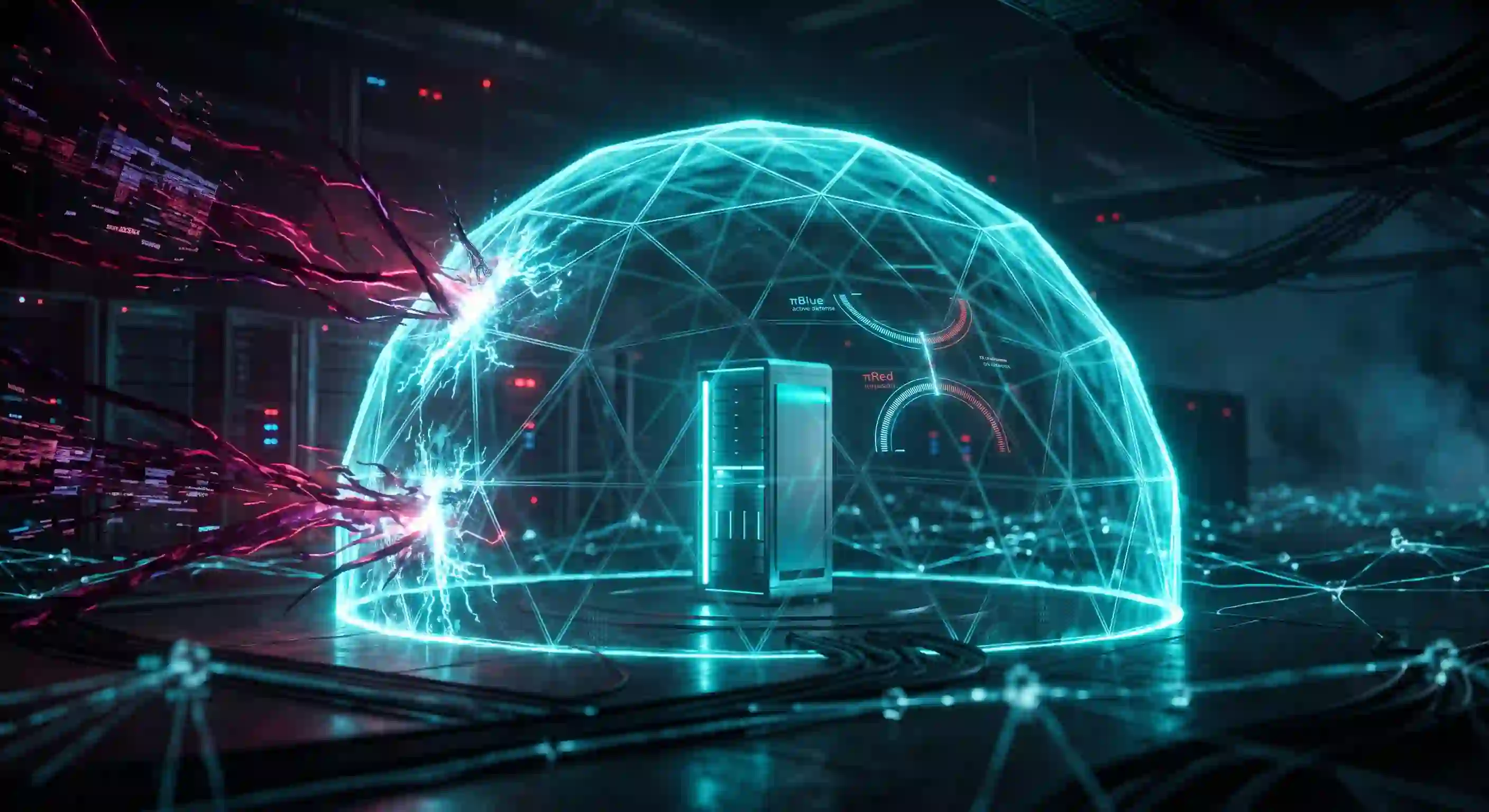
In modern server infrastructures, traditional monolithic control panels (cPanel, Plesk, etc.) create a broad attack surface due to continuously open management ports and heavy runtime processes, while significantly increasing cloud costs and carbon footprints through excessive resource consumption[cite: 1, 80]. RaTurka fundamentally transforms this paradigm through its minimalist SaaS architecture [cite: 1, 5]: RaGent (a .NET 10 NativeAOT agent consuming just 30 MB RAM) [cite: 1, 6], RaDome Edge Defense (an autonomous security shield inspired by military radome engineering) [cite: 1, 7, 20, 26], RaVision (an autonomous monitoring engine providing situational awareness) [cite: 1, 8], and RaWarden (a zero-trust access auditor)[cite: 1, 9]. This article explores the technical mechanics of RaDome’s autonomous edge defense, how the Causal Multi-Agent Decision Framework (C-MADF) prevents erroneous autonomous actions (negative externalities) [cite: 12, 15], and how Federated Learning powers a global, privacy-preserving threat intelligence ecosystem[cite: 18].
1. The Security Paradigm in Modern Server Architectures and the RaTurka Approach
Legacy server management systems rely on interpreted languages and heavy virtual machine (VM) runtimes, wasting valuable server hardware and exposing exposed management ports to continuous external reconnaissance[cite: 1, 2, 3]. In today’s Pay-As-You-Go cloud and VPS infrastructure, every idle CPU cycle and memory block consumed by an unoptimized control panel directly inflates operational expenditure[cite: 1, 4].
RaTurka redefines infrastructure management through a minimalist hybrid SaaS architecture coordinated across four core engineering components[cite: 1, 5, 6]:
- RaGent: A next-generation agent built with .NET 10 NativeAOT and zero-allocation C# design patterns, operating at a minimal 30 MB idle RAM footprint while communicating via Unix Domain Sockets (UDS) and mTLS-encrypted QUIC tunnels[cite: 1, 6].
- RaDome: An active security shield written in Rust that operates at the kernel boundary (eBPF/XDP) to provide autonomous real-time protection at the network edge[cite: 1, 7].
- RaVision: An autonomous monitoring system that constructs provenance graphs across processes, file access events, and network flows for complete situational awareness[cite: 1, 8, 14].
- RaWarden: A zero-trust enforcement mechanism that governs privileged access via break-glass approval workflows under a strict fail-closed posture[cite: 1, 9].
Legacy Panels vs. RaTurka Architecture: 30 MB RAM footprint instead of hundreds of megabytes of runtime overhead; zero-trust closed-port architecture instead of permanently exposed management ports; autonomous edge defense instead of reactive manual intervention [cite: 1, 10-19].
2. From Military Radome Engineering to the Digital Edge: RaDome Edge Defense
In military and aerospace engineering, a "radome" (radar dome) is a structural enclosure that protects sensitive radar and antenna mechanisms from environmental hazards (wind, ice, debris) while allowing electromagnetic signals to pass with minimal attenuation[cite: 2, 3, 4, 5]. In stealth applications, radomes integrate Frequency Selective Surfaces (FSS) and Frequency Selective Rasorbers (FSR) to selectively transmit operational frequencies while absorbing or reflecting out-of-band radar waves, thereby significantly reducing the system's Radar Cross Section (RCS)[cite: 7, 8].
RaDome Edge Defense translates these physical protection concepts directly to the digital server boundary[cite: 1, 26]:
| Physical Radome Engineering Principle | RaDome Cyber Equivalent | Security & Operational Benefit |
|---|---|---|
| Closed-Edge Sealing [cite: 6] | Zero-Trust Closed Port Architecture [cite: 1] | Completely blocks external port scanning and direct service discovery attacks[cite: 1]. |
| Impedance Matching (Stealth) [cite: 10, 11] | Silent Packet Dropping (Silent Drop) | Silently ignores packets from unauthorized IPs, making the host appear offline to automated scanning tools. |
| Frequency Selective Rasorber (FSR) [cite: 7] | Selective Network Traffic Filtering [cite: 1] | Passes legitimate management commands instantly while absorbing brute-force attempts and exploit payloads at the edge[cite: 1, 7]. |
| Dielectric Fluid Pressure Balancing [cite: 9] | DDoS & Volumetric Traffic Dampening [cite: 1, 9] | Dampens sudden traffic surges at the eBPF/XDP layer, preventing CPU/RAM exhaustion on the host[cite: 1, 9]. |
3. Autonomous Cyber Defense and Causal Decision Dynamics
Modern Advanced Persistent Threat (APT) actors routinely employ "Living off the Land" (LotL) techniques to hijack legitimate system binaries, hiding their telemetry footprints inside normal system noise[cite: 14, 15]. Static detection rules fail under these dynamic conditions[cite: 14]. However, full autonomy in cyber defense carries a major pitfall: negative externalities—such as an overzealous agent shutting down a critical production database, inflicting more financial loss than the attack itself[cite: 12, 15].
To eliminate uncontrolled decision-making risks, RaDome employs the principles of the Causal Multi-Agent Decision Framework (C-MADF)[cite: 15]. Security telemetry is compiled into a Structural Causal Model (SCM), and decision-making is arbitrated by a Council of Rivals comprising two opposing policies[cite: 15]:
- Active Threat Mitigation Policy (πBlue): Focuses aggressively on isolating threat vectors and stopping malicious progression[cite: 15].
- Conservative Business Continuity Policy (πRed): Ensures proposed mitigation steps do not disrupt legitimate business operations or system integrity[cite: 15].
Disagreement between these agents is mathematically quantified using the Policy Divergence Score (PDS) via Jensen-Shannon Divergence (DJS)[cite: 15]:
When the PDS crosses a predefined critical safety threshold, the system halts irreversible autonomous execution and safely escalates the incident to a Human-in-the-Loop workflow[cite: 12, 15]. Through evidence-grounded explainability layers (such as DeepFaith), complex graph outputs are instantly translated into concise natural language reports for SOC analysts[cite: 14].
4. Distributed Threat Intelligence and Collaborative Defense Architecture
The speed at which cyber threats propagate globally makes isolated single-server defenses obsolete[cite: 18]. However, centralizing raw logs, user traffic, and sensitive data to a single SIEM or cloud database incurs heavy bandwidth overhead and directly violates GDPR, KVKK, and financial privacy mandates[cite: 18, 19].
RaTurka resolves this operational and regulatory dilemma using a Federated Learning (FL) architecture[cite: 18]:
- Local Edge Training: Each RaTurka node trains its local machine learning models on its own telemetry; raw log data never leaves the server boundary[cite: 18].
- Privacy-Preserving Aggregation: Nodes share only trained model weights and gradient updates[cite: 18]. Mathematical noise is injected via Differential Privacy, and parameters are encrypted using Secure Multi-Party Computation (SMPC) to prevent reverse engineering of raw data[cite: 18].
- Model Poisoning Protection: Malicious or compromised nodes attempting to poison global intelligence are identified and filtered out using robust aggregation rules (Coordinate-wise Median / Trimmed Mean) and trust scoring[cite: 18].
Consequently, when a new zero-day vulnerability or False Data Injection (FDI) attack is detected on a single RaTurka node anywhere in the world, immunity updates are distributed across the entire global network within minutes[cite: 1, 18, 19].
5. Conclusion
RaTurka's .NET 10 NativeAOT-based, 30 MB idle RAM footprint sets a new standard for Green IT infrastructure management[cite: 1, 81]. Built on top of this efficient core, RaDome Edge Defense brings military-grade radome principles of sealing, stealth, and selective filtering to cyber operations[cite: 1, 2, 6, 7]. Backed by C-MADF causal decision dynamics to eliminate autonomous operational risks and Federated Learning for compliant global intelligence sharing, the RaTurka ecosystem elevates server management into a self-healing, zero-trust digital shield[cite: 1, 15, 18, 84].
References
- Öz, M. O. & Noyan, G. — RaTurka SaaS & Minimalist Server Management Architecture Articles, raturka.com.
- CommScope & IBERIA Compositech — Radar Dome (Radome) Engineering Standards and Electromagnetic Wave Propagation Principles.
- 4a Manufacturing — Open Edge vs. Closed Edge Radome Architecture & Dielectric Fluid Pressure Balancing.
- Zhang, Y., Goel, D., & Ahmad, H. (2026). Explainable Autonomous Cyber Defense using Adversarial Multi-Agent Reinforcement Learning (C-MADF). arXiv:2604.04442.
- Phan, T. V., Nguyen, T. G., & Bauschert, T. (2026). DeepFaith: Evidence-Grounded LLMs for Faithful Incident Reporting in Multi-Stage APT Defense. arXiv:2607.24348.
- Essien, I. A., et al. (2020). Federated Learning Models for Privacy-Preserving Cybersecurity Analytics. IRE Journals, 3(9), 2456-8880.
Related Posts
 Agent-Based Architecture
Is a 30 MB RAM Agent Possible? Server Management with .NET 10 NativeAOT
Discover how .NET 10 NativeAOT, zero-allocation C# patterns, and RaTurka's architecture enable a high-performance server agent operating on just 30 MB RAM.
 Agent-Based Architecture
Next-Generation Infrastructure Management: SaaS Control Panels vs. Traditional Hosting Panels
Compare traditional hosting panels with modern SaaS server management architectures. Discover RaTurka's 30MB RAM footprint and Zero-Trust security.
 MÖ
MÖ Agent-Based Architecture
Managing Servers Without Opening Ports: What Is Zero Inbound Port Architecture?
Discover how to manage servers securely without open inbound ports using Zero Inbound Port Architecture and RaTurka's lightweight 30 MB RAM agent platform.