
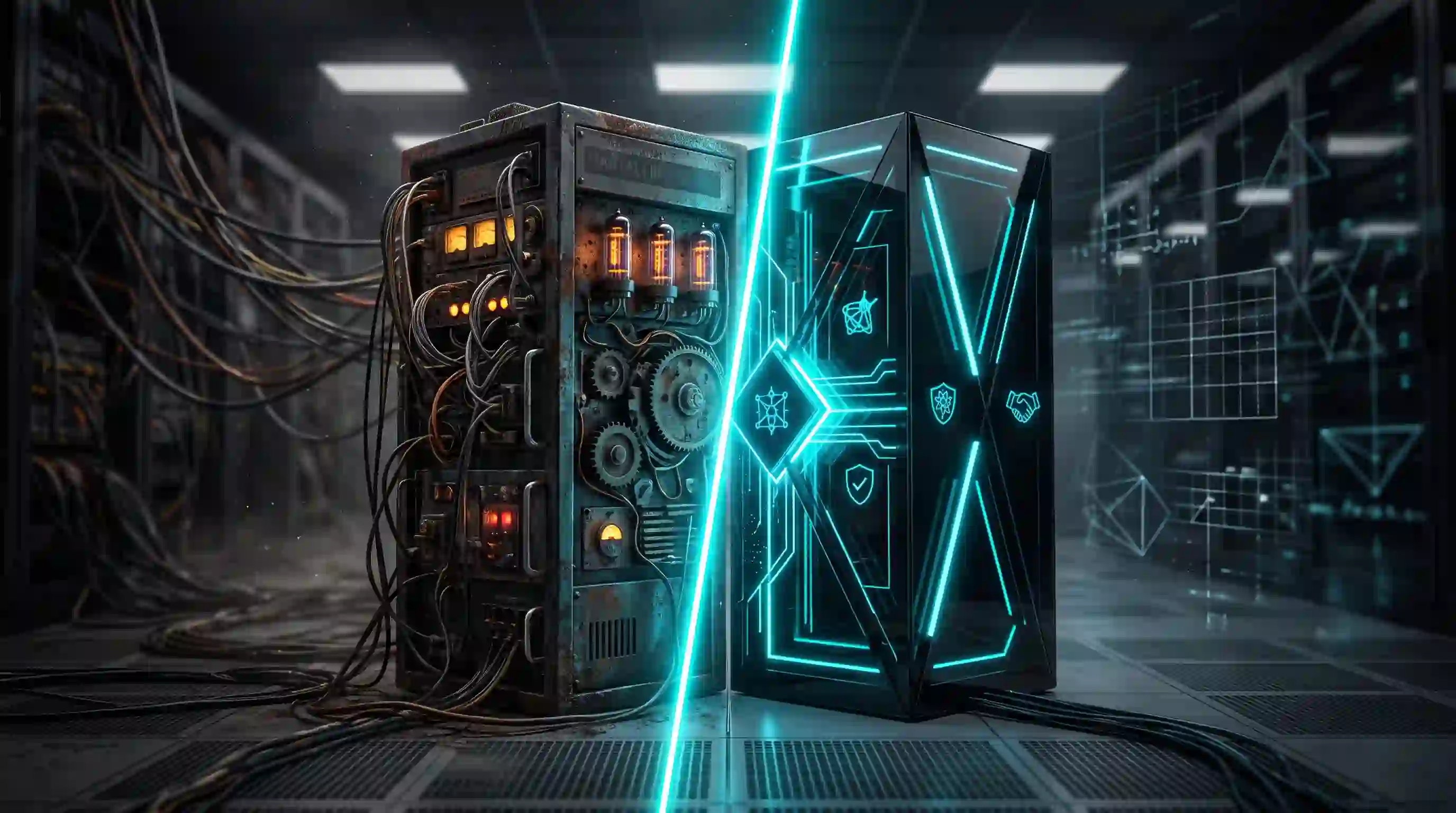
Next-Generation Infrastructure Management: SaaS Control Panels vs. Traditional Hosting Panels
📌 Executive Summary
In modern cloud environments, traditional monolithic control panels (such as cPanel and Plesk) create substantial operational overhead due to high memory consumption (500 MB – 1.2 GB RAM), publicly exposed management ports (2087, 8443, etc.), and escalating account-based licensing fees[cite: 2, 7, 8, 386, 603, 629, 694]. Next-generation SaaS and hybrid agent architectures shift the graphical user interface (UI) to a central cloud plane, keeping target servers completely invisible to external port scans under a strict zero-inbound port policy[cite: 3, 396, 398, 609, 612, 907]. This report examines the technical, security, and economic advantages of the RaTurka ecosystem (RaGent, RaVision, RaDome, and RaWarden)—a platform engineered under the leadership of Görkem Noyan and Mehmet Onat Öz [cite: 389], powered by .NET 10 NativeAOT to operate on a minimal footprint of just 30 MB RAM[cite: 1, 5, 416, 428, 637].
Introduction and the Paradigm Shift in Infrastructure Management
The rapid evolution of cloud computing, microservices, and containerized workloads (Docker, Node.js, etc.) has exposed fundamental flaws in traditional server management tools[cite: 1, 385, 602]. Legacy hosting panels designed decades ago attempt to run the user interface, web servers, database engines, mail daemons, and heavy log analyzers directly on the managed host[cite: 3, 386, 628]. This monolithic architecture frequently triggers Out-of-Memory (OOM) failures during intensive tasks like backup compression or statistics generation[cite: 1, 3, 400, 630].
Moving away from these resource-heavy legacy systems, RaTurka decouples the management UI from the host and executes only an ultra-lightweight execution agent (RaGent) locally[cite: 3, 5, 396, 397, 610]. By combining a Zero-Trust security model with distributed swarm threat intelligence, RaTurka delivers enterprise-grade protection while reserving nearly 100% of host hardware for revenue-generating workloads[cite: 1, 5, 6, 390, 391, 642].
Network Security and Attack Surface Comparison
Traditional control panels host their web-based interfaces directly on the target server, requiring administrative ports (e.g., 2087 for cPanel, 8443 for Plesk) to remain permanently listening on public IP addresses[cite: 2, 3, 393, 394, 606, 607]. These exposed ports serve as constant targets for automated brute-force attacks, botnets, and zero-day exploit attempts[cite: 2, 3, 395, 608].
In contrast, RaTurka’s hybrid SaaS model operates on an outbound-only communication flow[cite: 2, 3, 397, 612, 907]. The local agent establishes secure, mutually authenticated mTLS (Mutual TLS) and low-latency QUIC tunnels directly to the central control plane. Because zero inbound ports are opened for management, external network scans reveal a completely dark and invisible server surface[cite: 2, 3, 407, 612, 908].
Resource Consumption & Hardware Optimization (.NET 10 NativeAOT)
Management software written in interpreted or managed languages (such as Python, PHP, or Node.js) requires persistent runtime environments and virtual machines running on the host[cite: 1, 425, 633]. Dynamic Just-In-Time (JIT) compilation and aggressive Garbage Collection (GC) cycles cause unpredictable CPU spikes and memory bloat[cite: 1, 427, 634].
To eliminate runtime overhead, RaTurka’s RaGent is compiled directly into machine code using .NET 10 NativeAOT (Ahead-of-Time) technology. Operating without external dependencies, JIT delays, or managed VM overhead, the entire agent suite runs on an ultra-compact footprint of just 30 MB RAM[cite: 1, 5, 417, 428, 637, 850]. On entry-level VPS instances (1 GB – 4 GB RAM), this hardware efficiency yields massive operational savings across multi-server fleets[cite: 1, 5, 429, 639, 640].
The RaTurka Layered Defense Ecosystem
RaTurka implements a comprehensive defense-in-depth architecture across four specialized components[cite: 2, 5, 6, 413, 621, 960]:
- RaGent: The NativeAOT-compiled agent daemon responsible for host execution, container monitoring (Docker, Node.js), and telemetry dispatch at 30 MB RAM consumption.
- RaVision: AI-powered real-time session verification. It continuously validates and signs session tokens, preventing token theft, session hijacking, and concurrent multi-session abuses in real time[cite: 2, 5, 8, 418, 419, 431, 432, 621, 622, 623].
- RaDome: Distributed swarm immunity and edge defense platform. Utilizing kernel-level eBPF/XDP filtering, L7 AI WAF, and P2P threat propagation, any attack detected on a single node immediately updates protection rules across the entire global agent network.
- RaWarden: Zero-Trust SSH access gatekeeper built into OpenSSH via ForceCommand. Even if an operator presents a valid cryptographic key, root shell access remains frozen until human panel approval and single-use verification codes are validated.
Market Solutions vs. RaTurka Comparison Matrix
The table below provides a side-by-side technical evaluation of legacy, open-source, standard SaaS, and RaTurka control architectures[cite: 392, 403, 670]:
| Evaluation Parameter | Legacy Monolithic (cPanel / Plesk) | Open Source Local (CloudPanel / aaPanel) | Standard SaaS (RunCloud / Forge) | Next-Gen SaaS (RaTurka) |
|---|---|---|---|---|
| Architecture Model | Monolithic (UI on host) [cite: 3, 393, 404, 673] | Monolithic / Local [cite: 655, 673] | Hybrid SaaS [cite: 660, 662, 674] | Hybrid SaaS + Closed-Circuit On-Premise [cite: 10, 396, 405, 472, 674] |
| Idle Memory (RAM) | ~800 MB - 1.2 GB [cite: 629, 646, 677] | ~300 MB - 500 MB [cite: 651, 677] | ~80 MB - 150 MB [cite: 678] | Only 30 MB – 50 MB [cite: 1, 5, 12, 417, 428, 637, 678] |
| Exposed Inbound Ports | Multiple Ports Open (2087, 8443) [cite: 3, 394, 406, 607, 679] | UI Ports Open (8888, etc.) [cite: 680] | Port 22 (SSH) Open [cite: 680] | Zero Inbound Open Ports [cite: 3, 398, 407, 611, 681, 907] |
| Agent Binary Tech | Interpreted Daemons [cite: 633, 675] | Script-Based [cite: 633, 675] | Standard Compiled [cite: 676] | .NET 10 NativeAOT (Pure Machine Code) |
| SSH Gatekeeper | Standard Key/Password | Standard Key/Password | Static SSH Key Dependency [cite: 3, 4, 444, 614, 661, 718] | RaWarden Human-Approved Gate |
| Threat Protection | Local Rules (ModSecurity) [cite: 685] | Local Firewall / Fail2ban [cite: 659, 686] | Static Firewall Policies [cite: 686] | RaDome P2P Swarm Network Immunity |
Cost Model and Licensing Sustainability
Account-based licensing models heavily penalty high-density web servers[cite: 11, 15, 646, 694]. As client domains increase, traditional license fees scale exponentially[cite: 694]. RaTurka removes domain and resource limits across all plans, structuring predictable pricing based on organizational users and deployment modes[cite: 41, 700, 1017, 1018]:
| Plan Tier | Price (Monthly - Local / Cloud) | Included Users | Core Infrastructure Included |
|---|---|---|---|
| RaZero | Free [cite: 43, 706, 863] | 1 User / 1 Server [cite: 476, 707, 854, 931] | No credit card required, RaGent license included[cite: 13, 707, 863, 1017]. |
| RaTeam | $50.00 / $64.99 [cite: 41, 708, 1028, 1029] | 50 Users [cite: 41, 708, 1029] | Unlimited Domains, Mail, and Server Resources[cite: 41, 709, 1033, 1034]. |
| RaFleet | $80.00 / $99.99 [cite: 41, 710, 1028, 1029] | 100 Users [cite: 41, 710, 1030] | Reseller Infrastructure, RaVision Session Security[cite: 41, 711, 1035, 1036]. |
| RaCorp | $120.00 / $149.99 [cite: 41, 712, 1028, 1029] | 200 Users [cite: 41, 712, 1030] | Full Custom Branding & RaDome Standard Integration[cite: 41, 713, 1035]. |
Conclusion & Industry Projections
High resource footprints and public network vulnerabilities are accelerating the industry-wide shift away from legacy monolithic control panels[cite: 3, 477, 478, 715, 717]. RaTurka defines the new standard for modern cloud infrastructure management[cite: 390, 481]. Combining a 30 MB NativeAOT agent (RaGent), real-time session verification (RaVision), P2P network immunity (RaDome), and break-glass SSH access control (RaWarden), RaTurka establishes an uncompromised, highly efficient control plane for solo developers and enterprise engineering teams alike[cite: 5, 7, 391, 479, 480, 481, 719, 720].
References and Citations:
• RaTurka Platform Architecture & Technical Documentation (2026).
• Database Mart, cPanel vs CloudPanel Performance Benchmark Report (2026)[cite: 7, 722].
• RunCloud Technical Publications, Linux Server Hardening & VPS Security Guides (2025/2026)[cite: 30, 31, 37, 730, 731, 737].
• Apache APISIX & miniOrange, mTLS Implementation in Cloud & Multi-Agent Environments (2026)[cite: 32, 35, 732, 735].
Related Posts
 Agent-Based Architecture
Managing Servers Without Opening Ports: What Is Zero Inbound Port Architecture?
Discover how to manage servers securely without open inbound ports using Zero Inbound Port Architecture and RaTurka's lightweight 30 MB RAM agent platform.

 Agent-Based Architecture
Is a 30 MB RAM Agent Possible? Server Management with .NET 10 NativeAOT
Discover how .NET 10 NativeAOT, zero-allocation C# patterns, and RaTurka's architecture enable a high-performance server agent operating on just 30 MB RAM.
 Agent-Based Architecture
Avoiding cPanel and Plesk Price Hikes: Ways to Reduce Server Costs
Put an end to rising cPanel and Plesk licensing fees! Reduce your server costs with RaTurka’s RaGent architecture, which uses just 30 MB of RAM, and its built-in security shields.