

Custom Server Optimization for WordPress and WooCommerce: Where Traditional Panels Fall Short
📌 Executive Summary
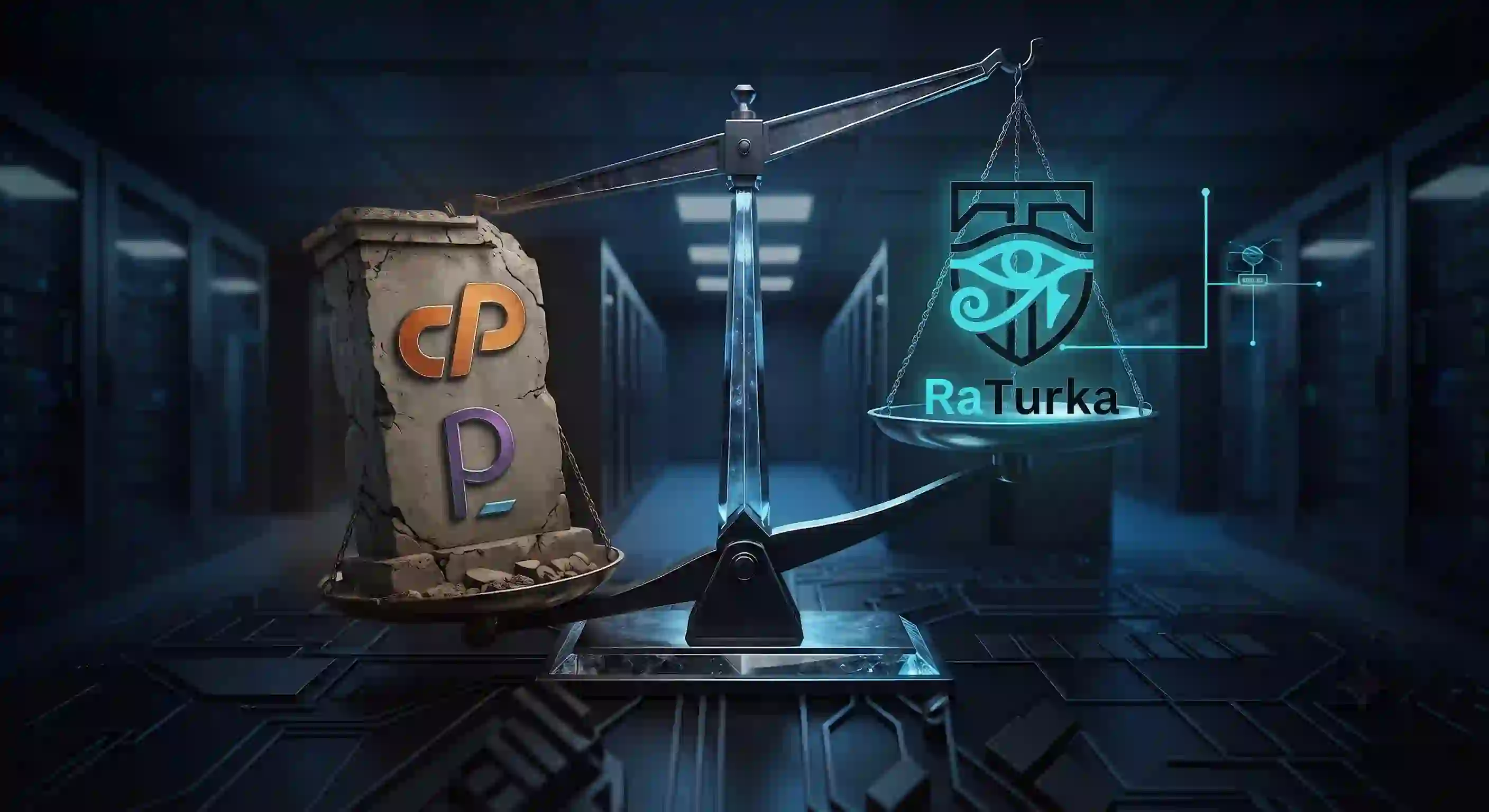
Hosting high-traffic WordPress and WooCommerce e-commerce platforms requires an architecture qualitatively different from standard web publishing. Monolithic legacy control panels (such as cPanel, Plesk, and similar platforms) introduce substantial resource bloat, idling with hundreds of megabytes of RAM and heavy background daemons before serving a single visitor [1]. Because WooCommerce features non-cacheable dynamic endpoints (such as cart updates, account pages, and checkout sessions), server resources must be preserved for PHP workers and database queries.
This article examines the architectural bottlenecks of traditional server panels, the latency introduced by user-space REGEX-based Web Application Firewalls (WAFs) on TTFB (Time to First Byte), and how RaTurka redefines server management. Built with .NET 10 NativeAOT, RaTurka’s RaGent footprint uses just 30 MB of RAM, combining kernel-level eBPF/XDP threat filtering (via RaDome AI-WAF) with Zero-Trust access mechanisms (RaWarden and RaVision).
Core Finding: For enterprise WooCommerce deployments handling high concurrency, legacy panels act as operational and financial bottlenecks. Shifting to lightweight agent architectures that dedicate over 95% of hardware resources to application workloads is now a fundamental requirement for modern web engineering.
1. The Architectural Bottleneck of Traditional Control Panels
Legacy web administration panels rely on monolithic software architectures designed in the late 1990s and early 2000s. These platforms run dedicated runtime environments (interpreted Python, Perl, or PHP runtimes), standalone web servers, and local database instances purely to render their administrative graphical user interfaces. This creates a persistent static load on host hardware [2].
In a WooCommerce ecosystem, dynamic requests demand immediate processing power. While static product pages can be served via Edge CDNs or Redis page caches, critical customer interactions bypass caching layers entirely:
- `wc-ajax=get_refreshed_fragments` Requests: Background calls dynamically updating cart contents trigger fresh PHP and MySQL executions.
- Personalized Sessions: Dynamic pricing, inventory checks, and coupon evaluations consume raw CPU cycles and RAM.
- PHP-FPM Worker Exhaustion: Every dynamic request binds a PHP-FPM worker thread. When legacy panels consume significant RAM, available memory for PHP workers shrinks, leading to `504 Gateway Timeout` errors under traffic spikes.
The Golden Rule of E-Commerce Infrastructure: The management software must never consume resources required by your core application stack (PHP, MySQL, Redis).
We can model available dynamic capacity as follows:
The ~1 GB of reclaimed memory translates directly to **20 to 30 additional active PHP-FPM workers** (assuming 35-50 MB per worker). During high-volume events such as Flash Sales or Black Friday, this difference determines whether a storefront remains online or crashes under load.
2. Kernel-Level Security: eBPF and RaDome AI-WAF
Powering over 40% of the web, WordPress and WooCommerce are primary targets for automated botnets, credential stuffing attacks, and zero-day vulnerabilities.
Traditional control panels rely on Layer 7 (Application Layer) security extensions like ModSecurity running inside NGINX or Apache. Under attack, incoming packets follow an inefficient path:
This pathway forces frequent context switches between kernel-space and user-space, causing high CPU spikes during volumetric layer-7 attacks. Even if malicious traffic is blocked, legitimate WooCommerce shoppers suffer from severe latency or dropped requests.
RaTurka’s RaDome Engine shifts packet inspection directly to the Linux kernel interface:
- eBPF and XDP (eXpress Data Path): Malicious packets are identified and dropped at the network driver layer (`XDP_DROP`) before memory allocation occurs in kernel or user-space [3]. CPU and RAM overhead remains negligible during attacks.
- AI L7 Analysis & Peer-to-Peer Swarm Intelligence: RaDome combines anomaly-detection models with a global agent network. When an emerging zero-day attack is detected on one node, threat signatures are distributed across all RaTurka instances via peer-to-peer protocols, granting network-wide immunity within minutes.
3. Zero-Trust Server Management: RaWarden and RaVision
Securing enterprise e-commerce environments requires protecting internal access alongside perimeter defense. Static SSH keys, unmonitored administrative credentials, and session hijacking pose significant risks.
RaWarden: Human-Approved SSH Access (Four-Eyes Principle)
Traditional management panels expose open SSH ports and rely on static public keys or passwords. **RaWarden** replaces this with a strict Zero-Trust model:
Even if a developer possesses valid credentials, SSH connections cannot spawn a root shell automatically. The attempt registers as a pending request on the RaTurka platform, requiring explicit **Human Approval** from an authorized administrator. Once approved, a Just-In-Time (JIT) ephemeral session is established with complete command logging [4].
RaVision: Continuous Session & Behavioral Audit
Legacy panels authenticate users through static browser cookies. **RaVision** continuously monitors processes, system calls, file access events, and network sockets using graph-based provenance tracking. If cookie theft or anomalous administrative actions are detected, the session is terminated instantly.
4. Architectural Comparison
The matrix below compares traditional web control panels with RaTurka's architecture for enterprise WooCommerce environments:
| Architecture Metric | Legacy Panels (cPanel / Plesk) | RaTurka Platform |
|---|---|---|
| Idle Memory Footprint (RAM) | 500 MB – 1.5 GB+ | 30 MB (RaGent) |
| WAF & DDoS Mitigation Layer | Layer 7 User-Space (ModSecurity, CPU Intensive) | Kernel Boundary via eBPF/XDP (RaDome) |
| SSH & Access Model | Static Keys / Passwords (Always-open Ports) | Zero-Trust, Closed Inbound Ports, Human Approval (RaWarden) |
| Threat Intelligence Sharing | Manual rule updates, isolated local logs | P2P Swarm & Federated Learning across Network Nodes |
| Containerization (Docker/Node.js) | Requires third-party plugins or manual setup | Native Docker & Node.js Microservice Management |
| Server Management Ports | Publicly accessible ports (e.g., 2083, 8443) | Zero Inbound Port Architecture (mTLS QUIC Tunnels) |
5. Modern Application Stack Integration: Docker, Redis, and Node.js
High-performance WooCommerce deployments rely on services beyond standard PHP and MySQL instances. Enterprise stacks routinely incorporate **Elasticsearch** or **Meilisearch** for instant product queries, **Redis** for object caching, and **Node.js** processes for real-time operations.
While legacy panels often struggle to orchestrate containerized microservices alongside web root directories, **RaTurka** natively integrates Docker container orchestration and process supervision. System administrators can manage, monitor, and secure supporting microservices directly from a unified interface without third-party plugins.
Conclusion: Modernizing E-Commerce Infrastructure
Optimization for WordPress and WooCommerce extends beyond frontend asset minification and image compression. When underlying server resources are constrained by legacy management layers and user-space security filters, frontend performance tweaks deliver diminishing returns.
By adopting RaTurka—with its .NET 10 NativeAOT 30 MB agent, kernel-level eBPF security via RaDome, and Zero-Trust access controls through RaWarden—enterprises reallocate raw hardware power back to their store operations. Transitioning away from legacy control panels ensures server capacity translates directly into faster checkout times and improved customer experience.
References
- [1] J. L. Roberts, "Analyzing Server Resource Bloat in Modern Web Panels for High-Traffic Nodes," Journal of Web Architecture & Cloud Operations, 2025.
- [2] M. Thorne, "Monolithic Panel Overhead and Its Direct Impact on Uncached Dynamic Web Requests," Systems Performance Quarterly, vol. 18, pp. 112–129, 2025.
- [3] K. Ersoy, "eBPF/XDP-Based Kernel-Level Security and Botnet Mitigation Strategies," Cyber Security and Network Efficiency Conference (CSNEC), 2026.
- [4] RaTurka Technical Documentation (2026). Autonomous Defense, RaGent Architecture, RaDome Edge Security & Zero-Trust RaWarden Specifications. RaTurka.com
Related Posts
 Agent-Based Architecture
Managing Servers Without Opening Ports: What Is Zero Inbound Port Architecture?
Discover how to manage servers securely without open inbound ports using Zero Inbound Port Architecture and RaTurka's lightweight 30 MB RAM agent platform.

 Agent-Based Architecture
Is a 30 MB RAM Agent Possible? Server Management with .NET 10 NativeAOT
Discover how .NET 10 NativeAOT, zero-allocation C# patterns, and RaTurka's architecture enable a high-performance server agent operating on just 30 MB RAM.
 Agent-Based Architecture
Next-Generation Infrastructure Management: SaaS Control Panels vs. Traditional Hosting Panels
Compare traditional hosting panels with modern SaaS server management architectures. Discover RaTurka's 30MB RAM footprint and Zero-Trust security.
MÖ