
VPS Cost Optimization Guide: How Control Panels Drain Server Resources

VPS Cost Optimization Guide: How Control Panels Drain Server Resources
While cloud computing and virtualization technologies have simplified infrastructure management, operational costs remain a critical parameter for businesses of all sizes. Especially on VPS (Virtual Private Server) nodes with limited resources—ranging from 1 GB to 4 GB of RAM—how efficiently your hardware is utilized directly impacts your budget. However, there is a significant, often overlooked cost factor in the modern hosting ecosystem: the resource consumption of the control panels installed to manage the server.
Many system administrators meticulously optimize their web applications to free up server capacity, yet they often overlook analyzing how much overhead the management panel or its underlying agent consumes in the background.
The Anatomy of Resource Consumption in Traditional Panels
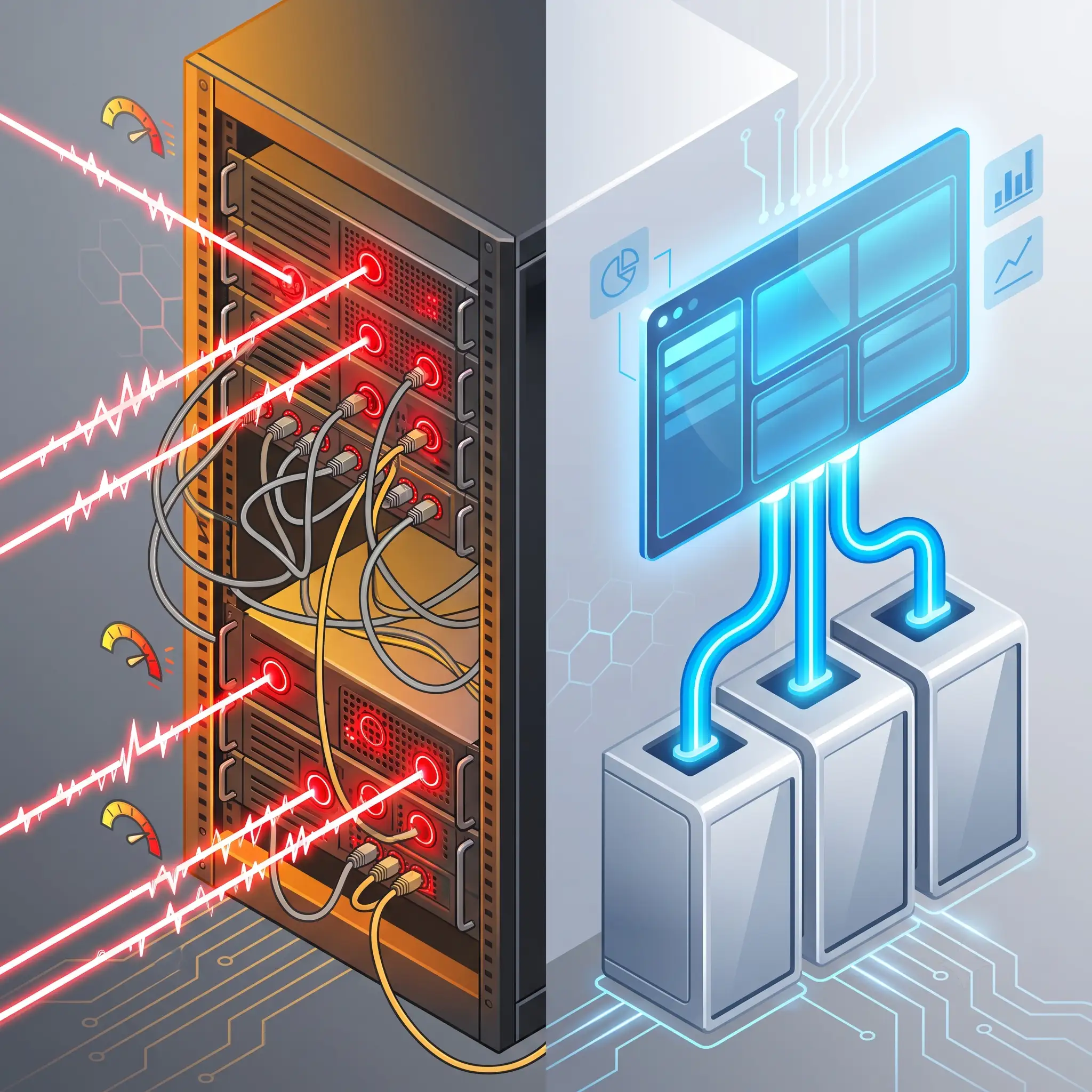
A large majority of popular and traditional control panels on the market operate as independent ecosystems on the server. This architectural approach introduces several inefficiencies:
- Heavy Runtime Dependencies: Management tools written in languages like Python, Java, Node.js, or PHP require interpreters and virtual machines to remain permanently active on the server. Consequently, the panel can consume hundreds of megabytes of RAM before any web application even receives traffic.
- JIT (Just-In-Time) Compilation Overhead: Systems dependent on managed runtimes compile code on the fly (JIT), causing temporary CPU spikes and triggering aggressive memory management cycles (Garbage Collection) that burden the host.
- Monolithic Service Structures: Massive background processes (daemons) running continuously just to handle simple configuration changes or metric tracking quickly exhaust the usable limits of small-scale servers.
"Sacrificing a significant portion of the hardware resources you purchased for your applications just to run the panel that manages them contradicts the core principles of cloud economics."
The Engineering Solution: Lightweight, Independent Agents via NativeAOT
Overcoming this inefficiency requires shifting the on-server management layer away from a bulky "panel" and toward a lightweight "agent" architecture that communicates directly with the operating system[cite: 1]. Modern software engineering answers this need through NativeAOT (Native Ahead-Of-Time) compilation technology[cite: 1].
An agent compiled with NativeAOT is converted directly into machine code, eliminating the need to install .NET, Python, or any other external runtime on the server[cite: 1]. It operates as a single binary, bypasses JIT compilation entirely, and optimizes memory management at the lowest level[cite: 1]. As a result, while traditional panels require hundreds of megabytes, a NativeAOT agent can reliably manage all server processes (Docker, databases, DNS, email) with a minimal footprint of just 30MB RAM.
Hidden Cost Savings in Scalable Infrastructures
The RAM savings achieved on a single server might seem modest; however, when managing a fleet of dozens or hundreds of servers, the mathematics change radically[cite: 1]. An extra 500 MB of RAM wasted per server translates to **50 GB of idle RAM costs** across an infrastructure of 100 servers.
Agent-based central management architectures offload heavy UI processing from the host server and move it to their own cloud layer[cite: 1]. Keeping only a lightweight agent on your server—one that simply executes commands, handles tasks, and transmits metrics—ensures that nearly 100% of your hardware budget is dedicated directly to your business-critical applications, databases, and APIs[cite: 1].
Conclusion
To extract maximum efficiency from your cloud infrastructure, you must scrutinize the footprint of every piece of software installed on your servers. Our **RaGent** agent, built on a .NET 9 NativeAOT foundation, delivers enterprise-grade management and cybersecurity capabilities while barely touching your server's hardware resources[cite: 1]. Optimizing server costs and utilizing every megabyte of your hardware efficiently, without compromising security, is the key to modern infrastructure management[cite: 1].